The Smart Data System (SDS) as a key innovation for sustainable digital transformation in food supply chains. The SDS is conceived not as “just another platform”, but as a systemic enabler: a holistic, evolving digital backbone of run-time services that interlinks stakeholders, harmonises heterogeneous data, and supports collaborative decision-making with sustainability “by design”, aligned with the Industry/Enterprise 5.0 direction.
The SDS is presented as a business process and exploitation-oriented framework combining platform capabilities, specifications, digital tools, and paradigms—intended to persist beyond the project lifetime.
The SDS Framework is currently under exploitation process by means of the Green Deal Support Office (GD-SO) Acceleration Service Line.
The SDS combines:
- Supply Chain Entities (SCEs): digital representations (digital twins) of supply chains or parts of them, enabling monitoring, evolution, and improvement over time.
- SDS Shared Space: the core hub providing connection infrastructure, a choreography view of the SCE, and dashboards for configuration and management.
- SDS Marketplace: a space where stakeholders can exchange services, apps, algorithms, datasets, and decision-support tools—lowering barriers for adoption and accelerating innovation.
- Trust & incentives: blockchain technologies that can support identity, reputation/assessment mechanisms, and trusted exchange patterns within the ecosystem.
- Decision support: a pathway to advanced, distributed decision-making—bridging research methods and operational tools, including Mixed Reality-enabled approaches.
SDS business framework (how the ecosystem works):
as a multi-sided ecosystem designed for long-term exploitation. The deliverable summarises four essential blocks:
- Stakeholders: buyers, sellers, developers, regulators, and communities participating in the SDS context
- SDS Marketplace: tools, products, and services offered to stakeholders
- SDS Business Unit: the nucleus intended to carry SDS technology and business forward after the project
- SDS Shared Space: the technical engine and integration hub for actors, choreography, and dashboards
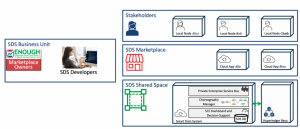
SDS business framework: stakeholders interact through the SDS Marketplace and the SDS Shared Space, supported by an SDS Business Unit for long-term exploitation.
The SDS framework is illustrated through four practical business use cases. Use case 1 – SCE lifecycle management shows how clients use the SDS Shared Space to configure, run, monitor, and continuously improve a Supply Chain Entity at both IT and OT levels, supported by dashboards, choreography management, integration services, and decision support (see Demo 1: https://enough-emissions.eu/demonstrator/demo-1-holistic-supply-chain-management-and-control/ ). Use case 2 – Buying from the marketplace focuses on extending the core platform by acquiring additional services such as decision-support applications, AI analytics, visualisation dashboards, and knowledge bases via SDS connectors. Use case 3 – Selling to the marketplace addresses how third parties can integrate and commercialise their solutions within the SDS Marketplace, connecting them to the SDS infrastructure and, when needed, exposing dedicated web interfaces through the SDS Shared Space. Finally, Use case 4 – Channelling innovation through the marketplace highlights how SDS owners can continuously introduce new modules and upgrades, enabling an evolutionary transition from project results to sustainable operational services.
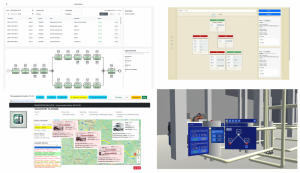
The SDS can act as a bridge between research and practice, for example by enabling the instantiation of a Mixed Reality + holonic decision-making methodology within a living supply chain scenario, connecting data acquisition through SDS connectors to collaborative optimisation among participants.
Contacts:
Luca Spalazzi: Università Politecnica delle Marche, l.spalazzi@univpm.it
Massimiliano Pirani: massimiliano.pirani@ieee.org